A Vancouver learning initiative

CelebratingSigdEthiopian Jewish Heritage

A gateway to Beta Israel—meaning “the House of Israel,” the historic name of the Ethiopian Jewish community—and to a living Jewish heritage of covenant, community and an enduring connection to Jerusalem.

Beta Israel—“the House of Israel”—is the ancient Jewish community rooted in Ethiopia. For centuries, Ethiopian Jews sustained a complete communal and religious world in the highlands of northern and northwestern Ethiopia. Despite geographic separation from other major Jewish centres, missionary pressure, dispossession and periods of persecution, the community preserved its Jewish faith, sacred learning, distinctive practices and enduring bond with Jerusalem.

Beta Israel preserves several traditions concerning its ancient origins, including descent from the Tribe of Dan and historical connections with Jewish communities in Egypt and southern Arabia. Scholars continue to investigate the earliest chapters of the community’s history, but Beta Israel’s Jewish identity does not depend upon any single historical theory. It was preserved by the community across generations and affirmed by leading rabbinic authorities.

Encountering Beta Israel widens our understanding of Jewish peoplehood. It brings Ethiopian Jewish voices, sacred traditions and cultural creativity into the shared life of Vancouver—and reminds us that Jewish continuity has always taken more than one form.

A story in images

Faith carried
across generations

From sacred leadership in Ethiopia to a renewed communal gathering in Jerusalem, these images trace continuity, covenant and belonging.

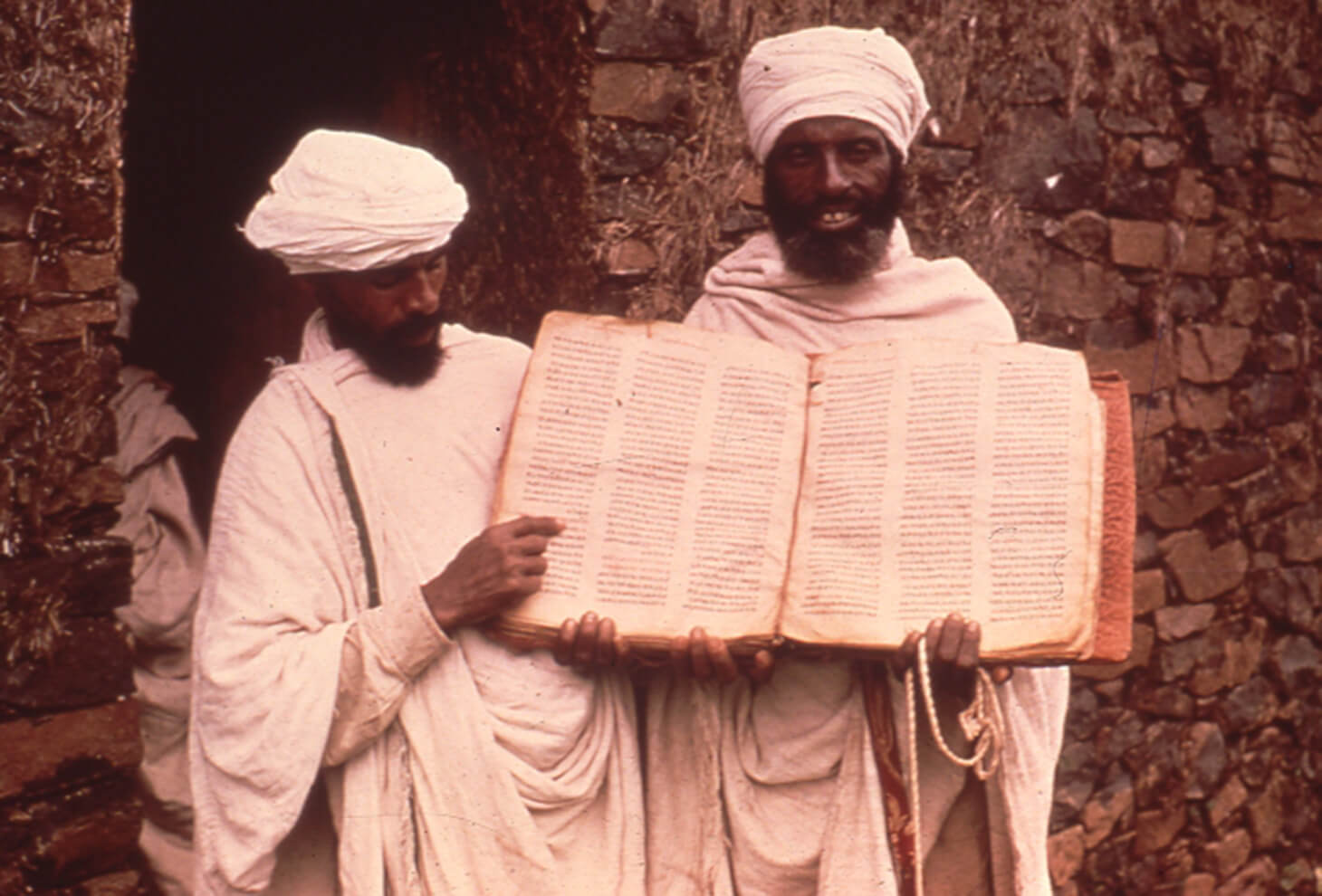
Qessim holding the Orit
Qessim holding the OritEthiopian Jewry Heritage CenterSource ↗
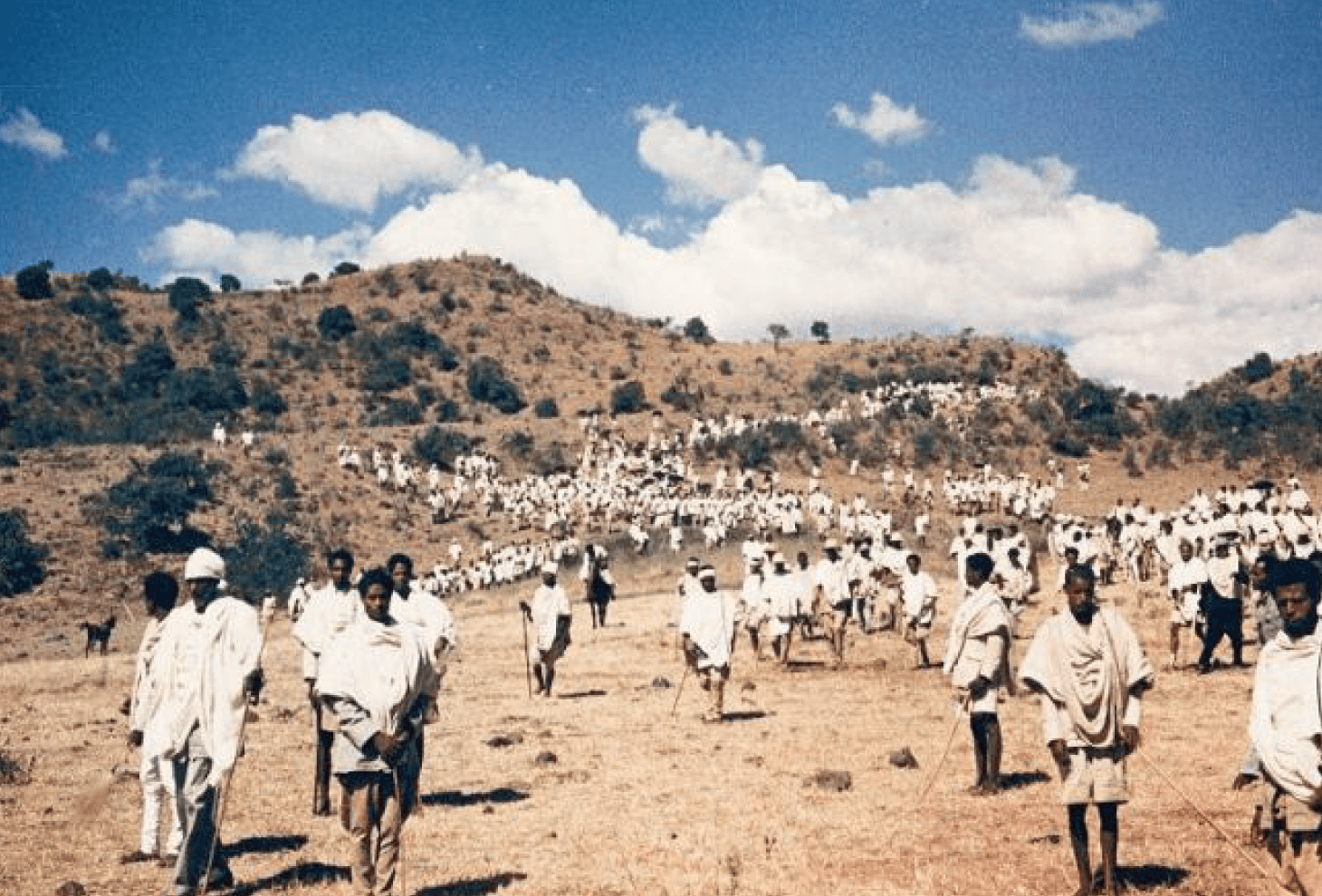
Sigd in Ambober, 1957
Sigd in Ambober, 1957Photograph: Yehuda SivanSource ↗

Explore directly

Two focused ways into the story

Open a dedicated page when you want to learn, teach or share one part of the project without sending the entire site.

01

The Journey of Beta Israel

Open and share the interactive, source-linked timeline.

Explore the timeline
02

People & Voices

Browse and share the leaders, educators, activists and cultural voices.

Meet the people

A shared Jewish story

Meet
Beta Israel

Come meet a part of the Jewish story you may not yet know—and perhaps discover that part of it already feels a little like your own.

Sacred life, leadership and learning

The community’s sacred literature was transmitted in Ge’ez. At its centre stood the Orit: the Five Books of Moses together with Joshua, Judges and Ruth. A broader sacred corpus included ancient Jewish works such as Jubilees and Enoch, preserved in full through Ethiopian manuscript traditions. The Qessim—Beta Israel’s spiritual leaders—served as teachers, judges and guardians of the Orit, guiding both religious and communal life.

Shabbat, prayer, fasting, dietary practice, circumcision, honouring parents and elders, hospitality, generosity and trust in God gave Jewish faith a daily form. These foundations connect Beta Israel unmistakably with Jews everywhere. Across centuries of geographic distance, Ethiopian Jewish life developed its own sacred language, melodies, customs and forms of leadership.

Shared Jewish foundations, a distinctive biblical heritage

Beta Israel and Jewish communities around the world share the central foundations of Jewish life: belief in one God, devotion to Torah, Shabbat, circumcision, sacred time, communal responsibility and a deep relationship with Jerusalem. Distinctive practices are not a measure of who is more or less Jewish; they are different historical expressions within one Jewish people.

Rabbinic Judaism developed through the Mishnah, Talmud and later halakhic literature, particularly after the destruction of the Temple. Beta Israel centred its religious life on the Orit, sacred Ge’ez texts, oral teaching and the leadership of the Qessim. As a result, some Beta Israel practices retained especially direct parallels to biblical law and to patterns associated with the biblical and Second Temple worlds.

Ritual purity remained a visible part of communal life in Ethiopia. It included purification after contact with death, immersion, and carefully observed periods connected with menstruation and childbirth. Ritual impurity does not mean dirtiness, inferiority or sin; it is a sacred legal category concerned with the boundaries of life, the body, death and holiness.

Jerusalem carried across generations

Although generations made their homes in Ethiopia, Jerusalem was never absent. It lived in prayer, song, celebration and mourning. The longing for Zion also inspired action, including Abba Mahari’s attempted journey toward Jerusalem in 1862. In the late twentieth century, Ethiopian Jews initiated journeys, organized families and routes, and worked with Israeli and international partners through Operation Moses, Operation Solomon and other aliyah efforts. Arrival fulfilled a centuries-old hope and opened a new chapter in preserving and renewing Ethiopian Jewish heritage in Israel.

Traditions of origin and Jewish belonging

Beta Israel’s Jewish belonging is the starting point. It was lived and preserved by the community across generations and affirmed in halakhic rulings by leading rabbinic authorities, including the Radbaz and Rabbi Ovadia Yosef. Scholars and community traditions offer several accounts of the community’s earliest history; those historical questions do not determine Jewish identity.

Community history and leadership ↗Orit manuscripts ↗

Why Vancouver?

A fuller Jewish story belongs to all of us.

Encountering Beta Israel widens our understanding of Jewish peoplehood. It brings Ethiopian Jewish voices, sacred traditions and cultural creativity into the shared life of Vancouver—and reminds us that Jewish continuity has always taken more than one form.

By returning to this learning each year, Sigd can become more than a single program. It can become a Vancouver tradition: a recurring moment for schools, synagogues, organizations and families to renew connection, deepen belonging and learn from a community that carried Jerusalem across generations.

Journey Through Time

The Journey of Beta Israel

Follow a Jewish journey of covenant, community, courage and return. Select a milestone for the story, the people who shaped it and further reading. As you move through time, look for the human choices, losses and hopes held inside the dates.

Community voices and sources included

The one-minute journey

Ancient traditions.
700+ years documented.
A living future.

Select a milestone to encounter community memory, sacred text, documented history and the people who carried the journey forward.

Jewish peoplehood · community tradition · scholarshipAntiquity

Jewish belonging & traditions of origin

Beta Israel is an ancient Jewish community that preserved Torah, prayer, Shabbat, covenant, communal leadership and an enduring connection to Jerusalem. Different traditions and scholarly approaches propose different accounts of the community’s earliest origins, but this historical discussion does not determine whether Beta Israel belongs to the Jewish people.

Why it matters

Beta Israel’s distinctive Ethiopian Jewish tradition is one expression of a much wider shared Jewish story. Its language, customs and historical path are distinctive; its foundations—Torah, covenant, prayer, Shabbat, Jerusalem, memory and peoplehood—create a deep common ground with Jews everywhere.

What we know
  • Community traditions connect Beta Israel with the Tribe of Dan, movement through Egypt or Kush, Jewish communities across the Red Sea, and the Solomon–Queen of Sheba–Menelik tradition.
  • Scholars have proposed ancient Jewish migration, the adoption of Jewish or biblical traditions by local Agaw-speaking populations, and gradual community formation through interaction between local and Jewish influences.
  • There is no single scholarly consensus about the earliest origin or migration route.
  • Within Judaism, Jewish status is determined by halakhic authority—not by a modern historical or genetic theory. Major rabbinic authorities recognized Beta Israel as Jews.
A living journey

The milestones connect community memory, sacred text and documented history. Source links are provided for readers who wish to continue learning.

People & Voices

Meet the people who shaped the journey

Begin with Ethiopian Jewish spiritual leaders, educators and activists, then meet the partners and advocates who joined their work across the wider Jewish world.

See their place in the shared journey →

23 people and groups

Ancient tradition

The Kessim

Historical institution · present

Spiritual and communal leaders

The Heritage Center describes the qesoch as teachers of Torah and religious law who led ceremonies, ruled on religious matters and helped resolve communal disputes.

Learn more

The Qessim carried sacred learning across generations. Their authority joined prayer and ritual leadership with teaching, judgment, pastoral responsibility and the care of communal relationships.

Explore through: Spiritual leadership · Sigd & tradition

Spiritual leadershipSigd & tradition
Source: EJHC: spiritual leadership ↗

Ancient tradition

Kes Menashe Zemro

1906–1998

Liqa Kahenat, teacher and senior spiritual leader

Ordained as a kes in Ethiopia in 1931, Zemro became one of Beta Israel’s most respected spiritual leaders. He defended the community’s religious tradition, worked for unity among Ethiopian Jewish immigrants and taught that patience preserves dignity and brings peace.

Learn more

Born in the village of Sanbatya in Gondar, Menashe Zemro studied for eight years with Beta Israel’s Jewish monastic teachers in the Semien Mountains and was ordained as a kes in 1931. He resisted missionary pressure, served communities across Ethiopia and later continued his leadership in Israel. At a Sigd gathering, he urged immigrants from different waves of aliyah not to judge one another: all were Beta Israel and part of Israeli society. His life joined fidelity to ancestral Torah with a commitment to dignity, patience, unity and peace.

Explore through: Spiritual leadership · Sigd & tradition · Community unity

Spiritual leadershipSigd & traditionCommunity unity
Source: The Daily Sage: Kes Menashe Zemro ↗

Life in Israel

Rabbi Dr. Sharon Shalom

Contemporary

Community rabbi, scholar, author and founder of the International Center for the Study of Ethiopian Jewry

Rabbi Dr. Sharon Shalom brings Beta Israel’s Torah, halakhah and living memory into conversation with rabbinic Judaism and the wider Jewish world. He serves as rabbi of the Kedoshei Yisrael community in Kiryat Gat and is a senior lecturer and founding director of the International Center for the Study of Ethiopian Jewry at Ono Academic College.

Learn more

Born in northern Ethiopia, Rabbi Dr. Sharon Shalom reached Israel as a child after the journey through Sudan and was later reunited with his family. He studied at Yeshivat Har Etzion, received rabbinic ordination and earned a doctorate in Jewish philosophy. In From Sinai to Ethiopia, he presents the halakhic and conceptual world of Beta Israel from within, asking how ancestral Ethiopian Jewish practice and rabbinic tradition can meet without erasing either one. In Dialogues of Love and Fear, he uses an imagined encounter between a kes’s son and a rabbi’s daughter to explore identity, authority, love, difference and the possibility of a shared Jewish future. As rabbi of the Kedoshei Yisrael community in Kiryat Gat—a synagogue founded by Holocaust survivors—and as founder and director of Ono Academic College’s International Center for the Study of Ethiopian Jewry, he embodies the bridge at the heart of his teaching: fidelity to inherited traditions together with dialogue, renewal and responsibility for the whole Jewish people.

Explore through: Spiritual leadership · Education · Jewish thought

Spiritual leadershipEducationJewish thought
Source: Ono Academic College: International Center for the Study of Ethiopian Jewry ↗

Early recognition

The RADBAZ

c. 1479–1573

Rabbi David ben Solomon ibn Abi Zimra

The Heritage Center identifies his ruling concerning Ethiopian Jews brought to Egypt as an early precedent later cited by Rabbi Ovadia Yosef.

Learn more

His responsum is important in later halakhic discussion because it treated Ethiopian Jews within a Jewish legal framework centuries before the modern State of Israel. The precise language of the responsum should be studied alongside later rulings rather than reduced to a slogan.

Explore through: Halakhic recognition

Halakhic recognition
Source: EJHC: rabbinic connections ↗

Renewed contact

Abba Mahari

19th century

Religious leader

Led a mass journey toward the Land of Israel in 1862. Many participants died and the survivors returned; the journey is remembered as an expression of longing for Jerusalem.

Learn more

The attempted journey of 1862 ended in loss and return, but it remained a powerful communal memory of Jerusalem as a lived religious aspiration rather than a distant symbol.

Explore through: Longing for Zion · Spiritual leadership

Longing for ZionSpiritual leadership
Source: Historical overview: 1862 journey ↗

Renewed contact

Rabbi Dr. Azriel Hildesheimer

1820–1899 · 1864 appeal

Rabbi, educator and early advocate for Beta Israel

In 1864, Hildesheimer publicly recognized Beta Israel as Jews and appealed to world Jewry to send funds, books, religious articles and a delegation. His call helped turn concern over missionary activity into organized Jewish action.

Learn more

Rabbi Azriel Hildesheimer was a major nineteenth-century Orthodox rabbi and educator. Responding to reports of missionary activity among Beta Israel, he issued a public appeal in 1864 describing them as fellow Jews and calling for practical aid. The appeal urged Jews across communal divisions to contribute money, books and religious articles and to send a delegation to Ethiopia. The Alliance Israélite Universelle later dispatched Joseph Halévy in 1867, marking an important stage in renewed contact between Beta Israel and world Jewry.

Explore through: Halakhic recognition · International advocacy

Halakhic recognitionInternational advocacy
Source: Hildesheimer’s 1864 appeal ↗

Renewed contact

Joseph Halévy

19th century

Emissary and scholar

Arrived in Ethiopia in 1867 after reports of missionary activity. His journey and report became an important stage in renewed contact between Beta Israel and other Jewish communities.

Learn more

His visit belongs to a nineteenth-century renewal of contact between Beta Israel and Jewish communities elsewhere. His writings helped draw attention to the community, while his perspective should also be read as that of an outside visitor.

Explore through: Research & encounter

Research & encounter
Source: Early Jewish contact with Beta Israel ↗

Education & connection

Dr. Jacques Faitlovitch

Late 19th–20th century

Educator and advocate

Worked to strengthen ties with world Jewry through advocacy, fundraising, opposition to missionary activity and educational infrastructure.

Learn more

His educational network created new links between Beta Israel and Jewish institutions abroad. Its legacy includes advocacy and opportunity, as well as significant changes in education, religious practice and relations with rabbinic Judaism.

Explore through: Education · International advocacy

EducationInternational advocacy
Source: EJHC: Faitlovitch ↗

Education & connection

Taamrat Emmanuel

20th century

Student who became a public leader

Named by the Heritage Center among the young Beta Israel students educated through Faitlovitch’s network who later served in government or community leadership.

Learn more

Educated through Faitlovitch’s network, Taamrat Emmanuel became an intellectual and public figure who moved between Ethiopian, Jewish and international worlds.

Explore through: Education · Public leadership

EducationPublic leadership
Source: EJHC: educational leadership ↗

Education & connection

Kes Aba Menase Yitzhak Yaso

1900–1995

Kes, teacher and community spiritual leader

A community biography describes him as a kes and teacher from the Tigray region who learned the sacred tradition from his father, Kes Zhabhar Yaso. He served Beta Israel communities in Ethiopia and later continued teaching and communal leadership in Israel, helping preserve the Orit, prayer and communal practice across generations.

Learn more

The biography supplied to the project remembers a life of religious teaching in Ethiopia and Israel. Further publication should preserve the family and community voice while separately verifying dates and institutional details.

Explore through: Spiritual leadership · Education · Sigd & tradition

Spiritual leadershipEducationSigd & tradition
Source: Community biography supplied to the project

Recognition & aliyah

Yitzhak (Tsehaye) Elias

20th century

Early immigrant, association member and community representative

The Hazi Ovadia Archive identifies Yitzhak Elias as one of the first members of the Association of Ethiopian Immigrants founded by Hazi Ovadia. The archive also names him among the young Ethiopian Jewish men whom Ovadia brought to meet Rabbi Ovadia Yosef during the discussions that preceded the rabbinic ruling concerning Beta Israel.

Learn more

His participation in the early immigrants’ association places him among those who represented Ethiopian Jewish concerns in Israel before the large rescue operations. The archival reference also connects him with the discussions that preceded Rabbi Ovadia Yosef’s ruling.

Explore through: Aliyah · Recognition · Community activism

AliyahRecognitionCommunity activism
Source: Hazi Ovadia Archive ↗

Recognition & aliyah

Rabbi Ovadia Yosef

1973 ruling

Sephardi Chief Rabbi and halakhic authority

Ruled in 1973 that Beta Israel are Jews. The Heritage Center records that the Law of Return was formally applied to Ethiopian Jews in 1975.

Learn more

His 1973 ruling was decisive for state and rabbinic recognition. The later application of the Law of Return opened a legal path for aliyah, although the community’s Jewish identity and longing for Jerusalem long preceded the ruling.

Explore through: Halakhic recognition

Halakhic recognition
Source: EJHC: immigration to Israel ↗

Rescue & advocacy

Baruch Tegegne

20th century

Ethiopian Jewish activist

The Heritage Center names him among activists who helped establish contacts and lay groundwork for a route through Sudan; the AAEJ records his international speaking and advocacy.

Learn more

His activism linked Ethiopian Jewish initiative with international advocacy. The story of aliyah was not only a rescue conducted from outside; Ethiopian Jews themselves organized, communicated and pressed for action.

Explore through: Community activism · Aliyah

Community activismAliyah
Source: AAEJ: institutional history ↗

Rescue & advocacy

Ferede Aklum

20th century

Teacher, educator and activist

Aklum fled the Mengistu regime and reached Sudan. From Khartoum he sent a letter to Chaim Halachmi; this contact became the first step in opening the clandestine Sudan route later used by thousands.

Learn more

From Sudan, Aklum helped create contact that contributed to the clandestine route later used by thousands. His story highlights the agency, risk and local knowledge of Ethiopian Jewish activists within the wider rescue effort.

Explore through: Rescue routes · Aliyah · Community activism

Rescue routesAliyahCommunity activism
Source: Sudan journey: Ferede Aklum ↗

Rescue & advocacy

Chaim Halachmi

1979 · opening of the Sudan route

Israeli contact in the earliest stage of the Sudan route

After reaching Khartoum, Ferede Aklum sent Halachmi a letter seeking help. The surviving account describes this message as the first step in opening the clandestine route through Sudan.

Learn more

The available published account identifies Chaim Halachmi as the recipient of Ferede Aklum’s letter from Khartoum. That letter connected Aklum’s initiative on the ground with contacts in Israel and is described as the first step in opening the secret route through Sudan. Because accessible biographical documentation about Halachmi remains limited, this card confines itself to that documented role.

Explore through: Rescue routes · Aliyah · International advocacy

Rescue routesAliyahInternational advocacy
Source: Sudan journey: Aklum’s letter to Halachmi ↗

Rescue & advocacy

William “Will” Recant

1986–2023 · AAEJ and JDC

Humanitarian leader and advocate for Ethiopian Jewry

Recant led international advocacy for Ethiopian Jewry, established a 144-member Congressional Caucus and helped advance Operation Solomon. At JDC, he directed humanitarian and Jewish community-development work in more than 30 countries.

Learn more

Born and raised in New York City, Dr. William Recant served as Executive Director of the American Association for Ethiopian Jews from 1986 to 1993. He led global advocacy, established the Congressional Caucus for Ethiopian Jewry, supported the movement of thousands of Beta Israel from Gondar to Addis Ababa and worked with Israeli and U.S. officials in the planning and implementation of Operation Solomon. From 1993 to 2023, he held senior leadership roles at the American Jewish Joint Distribution Committee, directing humanitarian aid and Jewish community-development programs across Latin America, Europe, Africa and the former Soviet Union.

Explore through: International advocacy · Political action

International advocacyPolitical action
Source: Greater Miami Jewish Federation: William Recant ↗

Life in Israel

Dr. Shula Mola

Contemporary

Educator, scholar and civil-rights activist

Mola served as executive director and later chair of the Association for Ethiopian Jews. Her scholarship and public work address belonging, social inequality, racism and the leadership of Ethiopian Israelis within Israeli society.

Learn more

Mola reached Israel as a child after the journey through Sudan and became a leading educator, researcher and civil-rights activist. During many years at the Association for Ethiopian Jews, including as executive director and chair, she worked to challenge unequal systems and strengthen community voice. Her research on Black identity and social stratification adds an Ethiopian Israeli perspective to wider conversations about Jewish belonging and shared responsibility.

Explore through: Community activism · Education · Human rights

Community activismEducationHuman rights
Source: Brandeis University: Dr. Shula Mola ↗

Life in Israel

Dr. Nigist Mengesha

Contemporary

Social worker, educator and community leader

Mengesha helped develop culturally informed educational mediation and served as director-general of the Ethiopian National Project. Her work has connected schools, families and communal leadership while advancing Ethiopian Israeli participation and opportunity.

Learn more

Born near Gondar, Mengesha worked as a social worker in Ethiopia before making aliyah in 1984. In Israel she earned advanced degrees, co-founded the FIDEL Association and helped train Ethiopian Israeli educational mediators who connected families and schools. As director-general of the Ethiopian National Project, she emphasized not only integration but the community’s own knowledge, leadership and resources.

Explore through: Education · Community activism · Public leadership

EducationCommunity activismPublic leadership
Source: Jewish Women’s Archive: Dr. Nigist Mengesha ↗

Life in Israel

Judges Adenko Sabhat-Haimovich & Esther Tapeta Gardi

Appointed 2016

Israel’s first women judges of Ethiopian origin

Their appointments—to the Magistrates’ Court and Traffic Court—marked a historic first for Israelis of Ethiopian origin in the judiciary. Their achievement widened representation in a central institution of Israeli public life.

Learn more

In 2016, Adenko Sabhat-Haimovich and Esther Tapeta Gardi were selected and sworn in as Israel’s first two women judges of Ethiopian origin. Sabhat-Haimovich was appointed to a Magistrates’ Court and Tapeta Gardi to a Traffic Court. Their appointments were personal professional achievements and a public milestone, allowing young Ethiopian Israelis to see themselves represented within Israel’s judiciary.

Explore through: Public leadership · Law & justice · Women’s leadership

Public leadershipLaw & justiceWomen’s leadership
Source: Times of Israel: first two women judges of Ethiopian origin ↗

Life in Israel

Kabra Kasai

Contemporary

Singer, songwriter and performer

Kasai became widely known through her work with the Idan Raichel Project and performances in Hebrew and Amharic. Her voice helped bring Ethiopian Israeli sound and identity into the centre of Israeli popular music.

Learn more

Born to Ethiopian Jewish parents during the journey through Sudan and raised in Israel, Kabra Kasai developed a musical life shaped by Amharic music at home and a broad range of Israeli and international sounds. She gained national and international recognition through the Idan Raichel Project, including songs such as Bo’ee and Milim Yafot Me’Eleh, while continuing to develop her own voice as a performer and songwriter.

Explore through: Music & culture · Public voice

Music & culturePublic voice
Source: Artist biography: Kabra Kasai ↗

Life in Israel

Susan Pollack

AAEJ/FEJ · present

Archivist and advocate

The AAEJ site lists Pollack among its activists and identifies her as director of AAEJ Archives Online, which she created with Asher Elias and LaDena Schnapper.

Learn more

Her work joined advocacy with the preservation of records. By building and directing AAEJ Archives Online, she helped make the history of the movement—and the voices within it—available for continued research.

Explore through: Human rights · Family reunification

Human rightsFamily reunification
Source: AAEJ: archive contact page ↗

Life in Israel

Rabbi Menachem Waldman

Contemporary

Rabbinic scholar and activist

A publisher biography describes him as a veteran activist for the aliyah and absorption of Ethiopian Jewry. This profile is provisional pending review of a primary or institutional record.

Learn more

His published work and activism concern the aliyah, absorption and religious heritage of Ethiopian Jewry. This card remains provisional until an institutional or primary biographical record is reviewed.

Explore through: Education · Family reunification

EducationFamily reunification
Source: Publisher biography · provisional ↗
Continue learning: Each card links to further reading where a direct source is available. The card for Kes Aba Menase Yitzhak Yaso preserves a community biography supplied to the project.

Covenant • Community • Jerusalem

What is Sigd?

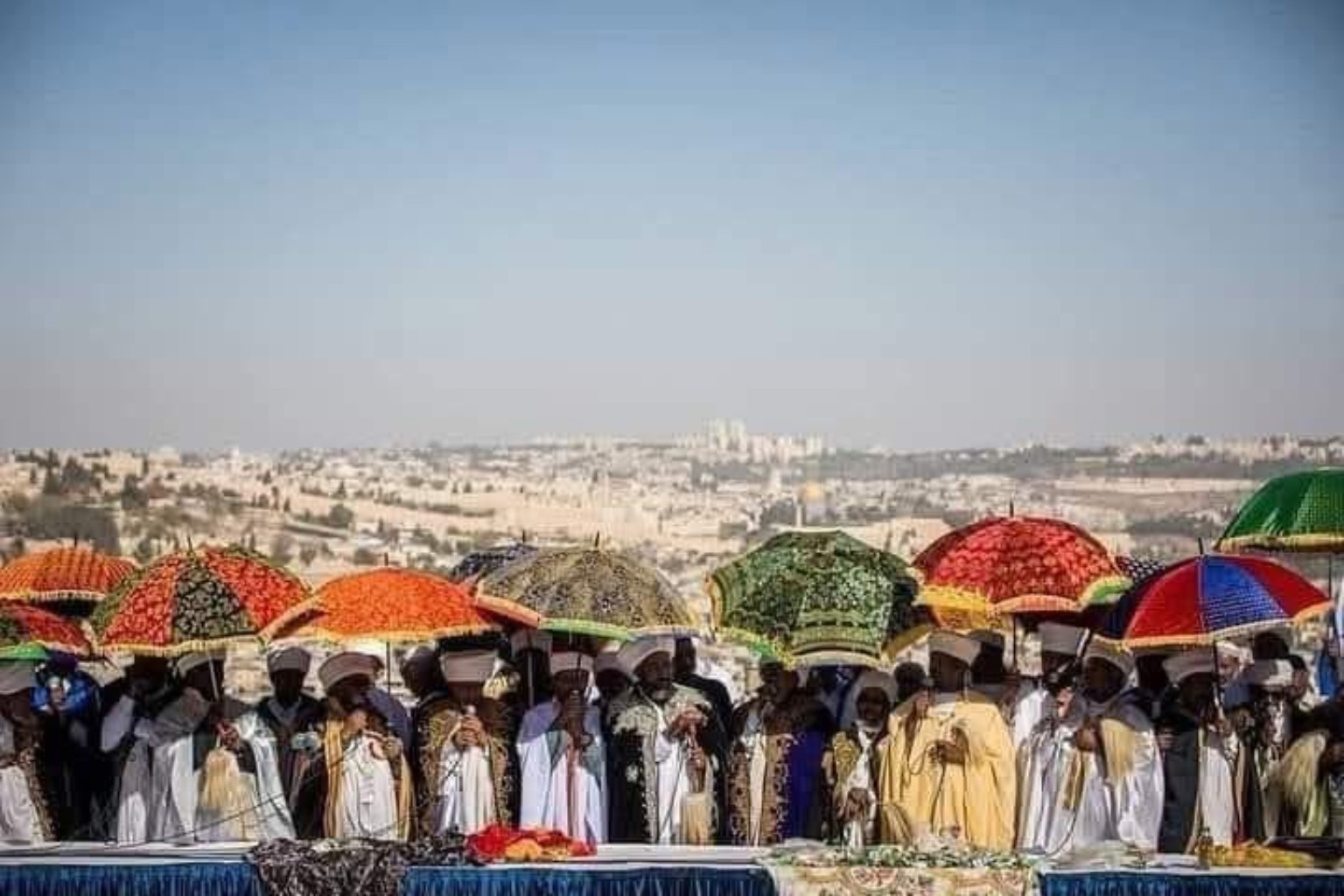
Qessim gathered beneath colourful ceremonial umbrellas during Sigd in Jerusalem
Qessim and the community gather for Sigd in Jerusalem.

You may know Yom Kippur. Now encounter how a familiar Jewish idea—reflection, return and renewed commitment—took another form in a Jewish community that lived for centuries at a great geographic distance from other major centres of Jewish life.

Sigd is observed on 29 Heshvan, fifty days after Yom Kippur—echoing the fifty-day relationship between Passover and Shavuot. It is a day of fasting, purification, prayer and renewal of the covenant between the people, God and the Torah. Where Yom Kippur centres personal and communal repentance, Sigd gives special form to the community gathering as one to renew its covenant. The name is connected with prostration and worship; the day is also known as Mahalala, associated with supplication and seeking forgiveness.

In Ethiopia, people prepared through reconciliation and purification, dressed in festive white clothing and gathered before dawn. Led by the Qessim—the community’s spiritual leaders—they carried the Orit from the place of prayer and ascended a high mountain. The ascent recalled Mount Sinai and created a physical and spiritual movement away from everyday life toward prayer, reflection and renewed commitment.

At the summit, the community fasted, bowed in prayer and listened to passages concerning the giving of the Torah, covenant, blessing and repentance. The public reading and renewal described in Ezra and Nehemiah provide an important biblical model for the day. When the solemn service ended, participants descended in song and dance, broke the fast and shared a festive communal meal.

Jerusalem stood at the heart of Sigd long before most members of Beta Israel reached Israel. After aliyah, longing for Jerusalem gained another layer: gratitude for arrival, together with responsibility to preserve the tradition and pass it to the next generation. In 2008, the Knesset recognized Sigd as a national holiday.

Today the best-known public gathering takes place on the Armon Hanatziv promenade, overlooking the Old City and the Temple Mount. This is not the only Jerusalem observance: prayers and a Sigd ceremony are also held at the Western Wall Plaza, and official educational materials describe the two sites side by side. The gatherings express the same enduring themes—covenant, repentance, communal unity and connection to Jerusalem.

Sources for this section
Bring Sigd learning to your community →

Made for you to use

Discover
Beta Israel

A Community Learning Toolkit

Begin by browsing everything in the toolkit: lesson plans, games, the quiz, creative activities, books, music, video, foodways and other cultural resources.

Qessim holding the Orit, the sacred text of Beta Israel
Living Jewish heritageEthiopian Jewry Heritage Center ↗

Heritage in everyday life

Recipes, Video
& Comedy

Food, film and humour open welcoming pathways into Ethiopian Jewish experience—making room for memory, creativity, conversation and joy.

01

Recipes & Foodways

Explore the foods, preparation traditions and hospitality that bring families and communities together.

Recipes and hosting guides will be curated here.
02

Video & Film

Discover interviews, documentaries, performances and short educational clips that centre Ethiopian Jewish voices.

Videos will be organized by age, theme and length.
03

Comedy & Conversation

See how humour can illuminate identity, family, language, belonging and the Ethiopian Israeli experience.

Context notes will help facilitators use each selection thoughtfully.

Books & Stories

A library of living heritage

Fifty carefully selected books in English and Hebrew—for scholarship, community learning and reading together.

Links lead to a lawful full text when one is openly available; otherwise to a publisher, library, preview or borrowing record.

Showing 10 of 50 titles

Cover of From Africa to Zion
Memoir & BiographyFrom Africa to ZionDanny Adeno Abebe
EnglishExact title record linked

From Africa to Zion

Danny Adeno Abebe

The journey of a shepherd boy who became Israel’s first Ethiopian-born journalist—and a candid account of belonging.

Review & purchase links ↗
Cover of המסע לא תם
Memoir & Biographyהמסע לא תםדני אדינו אבבה
HebrewExact title record linked

המסע לא תם

דני אדינו אבבה

סיפור חיים מאתיופיה לעיתונות הישראלית, לצד מבט מפוכח על קליטה, גזענות וזהות.

Exact book page ↗
Cover of Identity in Doubt / זהות בספק
Memoir & BiographyIdentity in Doubt / זהות בספקRachel Derrer-Leibowitz / רחל דרר־ליבוביץ
HebrewExact title record linked

Identity in Doubt / זהות בספק

Rachel Derrer-Leibowitz / רחל דרר־ליבוביץ

A personal search for family, Jewish identity and belonging. This catalogue records the verified Hebrew edition.

Library catalogue ↗
Cover of Dialogues of Love and Fear
Memoir & BiographyDialogues of Love and FearRabbi Dr. Sharon Shalom & Ronit Irshai
EnglishExact title record linked

Dialogues of Love and Fear

Rabbi Dr. Sharon Shalom & Ronit Irshai

A rabbi who is the son of a Kes and a rabbi’s daughter speak candidly about tradition, gender, race and a shared future.

Find the book ↗
Cover of Transformations: From Ethiopia to Israel
Memoir & BiographyTransformations: From Ethiopia to IsraelRicki Rosen; essay by Micha Odenheimer
EnglishExact title record linked

Transformations: From Ethiopia to Israel

Ricki Rosen; essay by Micha Odenheimer

Paired photographs and life stories revisit Ethiopian Israelis years after Operation Solomon.

Review & purchase links ↗
Cover of The Ethiopian Jews of Israel
Memoir & BiographyThe Ethiopian Jews of IsraelLen Lyons; photographs by Ilan Ossendryver
EnglishExact title record linked

The Ethiopian Jews of Israel

Len Lyons; photographs by Ilan Ossendryver

More than fifty portraits and first-person accounts reveal the variety of Ethiopian Jewish life in Israel.

Review & purchase links ↗
Cover of Drawn from Water
Memoir & BiographyDrawn from WaterDina Elenbogen
EnglishExact title record linked

Drawn from Water

Dina Elenbogen

A poet’s long friendship with an Ethiopian Israeli family becomes a reflective story of home, inequality and kinship.

Review & purchase links ↗
Cover of Rescue the Ethiopian Jews!
Memoir & BiographyRescue the Ethiopian Jews!Graenum Berger
EnglishExact title record linked

Rescue the Ethiopian Jews!

Graenum Berger

A grassroots organizer’s memoir of four decades advocating for recognition, rescue and aliyah.

Find or borrow ↗
Cover of Black Jews, Jews, and Other Heroes
Memoir & BiographyBlack Jews, Jews, and Other HeroesHoward M. Lenhoff & Jerry L. Weaver
EnglishExact title record linked

Black Jews, Jews, and Other Heroes

Howard M. Lenhoff & Jerry L. Weaver

A participant history of the North American movement whose sustained activism helped change public policy.

Find or borrow ↗
Cover of Yona Bogale: Hero and Savior of Ethiopian Jews
Memoir & BiographyYona Bogale: Hero and Savior of Ethiopian JewsZecarias Yona
EnglishExact title record linked

Yona Bogale: Hero and Savior of Ethiopian Jews

Zecarias Yona

A biography of the educator and leader who built schools, cultivated international ties and advanced aliyah.

Find or borrow ↗

Reading note: Begin with memoir, community voices and stories for young readers. Links lead to publishers, libraries or borrowing records; historical titles that use outdated terminology are identified in context.

Music & Song

Listen across generations

Begin with Qessim, community repertoire and Ethiopian-Israeli artists—including Café Shahor Hazak, Ester Rada, Gili Yalo, Ayala Ingedashet and Orit Tashoma—then explore collaborations across Israeli music.

Hebrew

Heritage & Shabbat

Specific source linked

Shabbat Songs in Ethiopian Melodies

The Goshen Family / משפחת גושן

A family collection that carries familiar Shabbat texts through Ethiopian melody and rhythm.

Open exact source ↗
Hebrew & Amharic

Heritage & Shabbat

Specific source linked

Atah Abati — You Are My Father / אתה אבאתי

Beta Israel community repertoire

A devotional bridge between the Hebrew address ‘You are my Father’ and the Amharic word abati, ‘my father.’

Open exact source ↗
Ge’ez & Amharic

Heritage & Shabbat

Specific source linked

Sigd Prayers and Piyyutim

Qessim and community singers

Prayer, call-and-response and communal song surrounding covenant, Jerusalem and Sigd.

Open exact source ↗

Listening note: Links open the specific recording or source attached to each card. Facilitators should preview recordings before public use and centre the artists’ own voices and context.

Colour & Create

Learning through art

Print-ready activities for families, classrooms and community gatherings. Select a page to view it at full size or download it for printing.

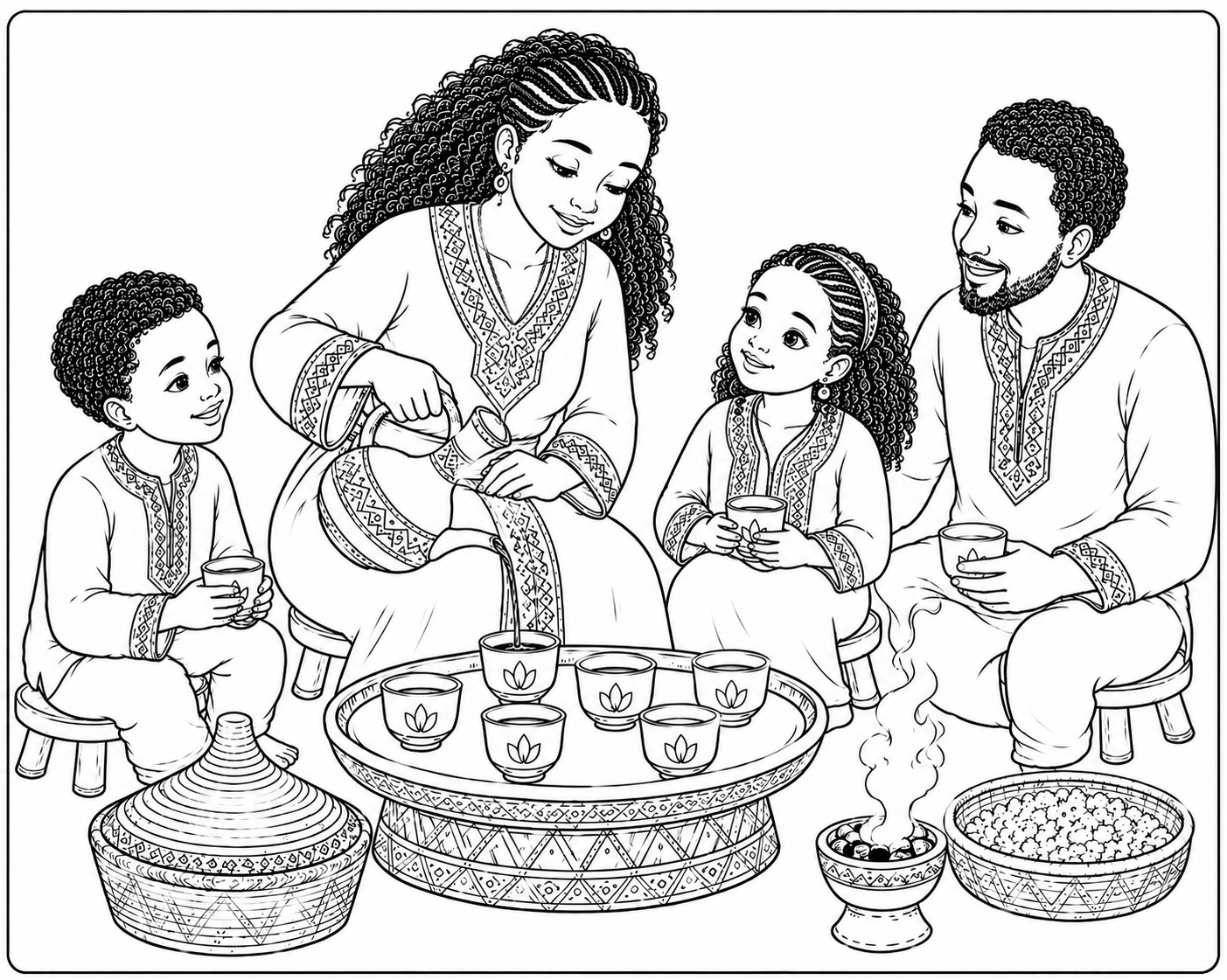
Family Buna Ceremony colouring page

Family Buna Ceremony

A family gathering around the traditional Ethiopian coffee ceremony.

Download PNG ↓
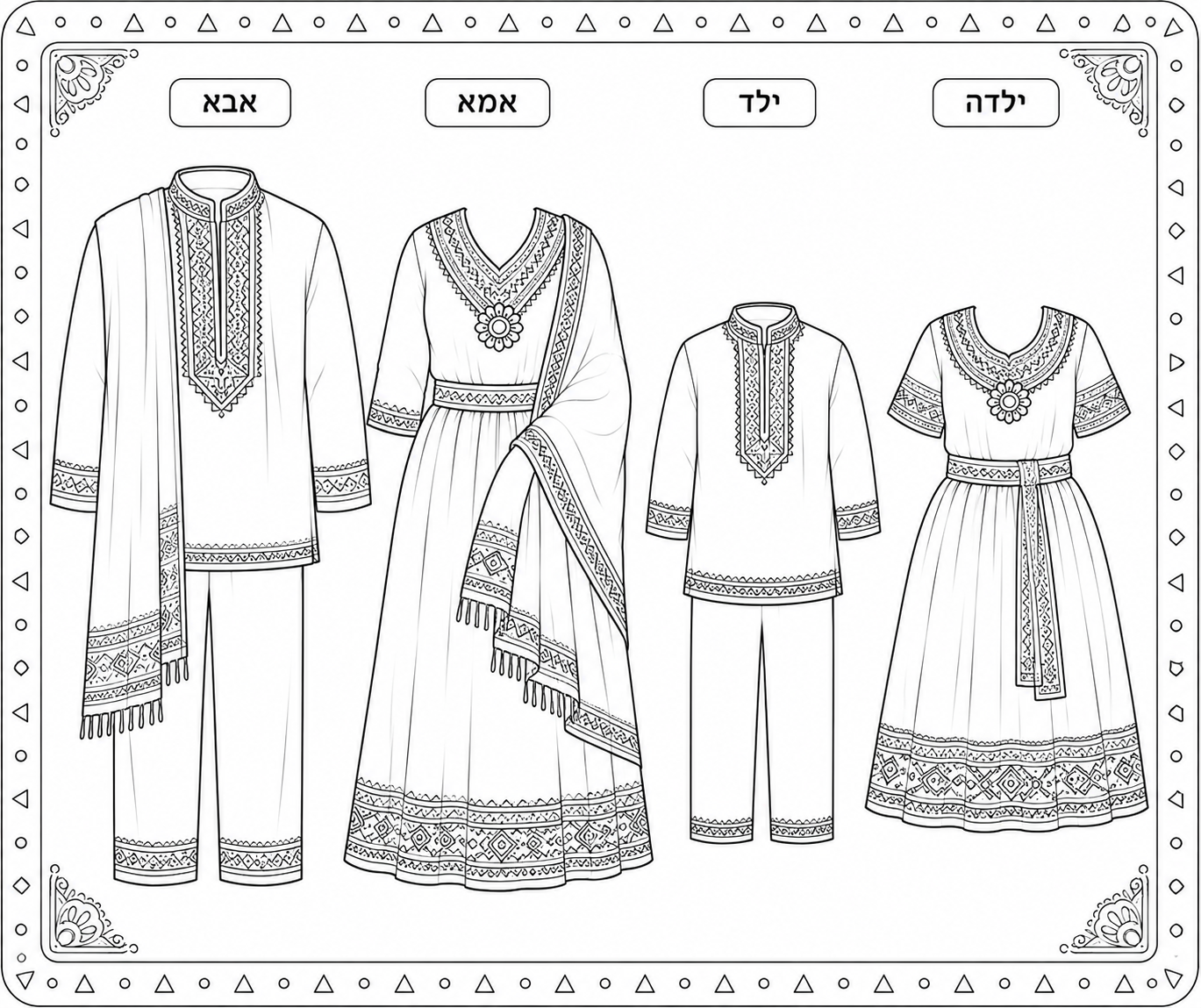
Ethiopian Clothing Paper Dolls colouring page

Ethiopian Clothing Paper Dolls

Colour and explore clothing for an intergenerational family.

Download PNG ↓
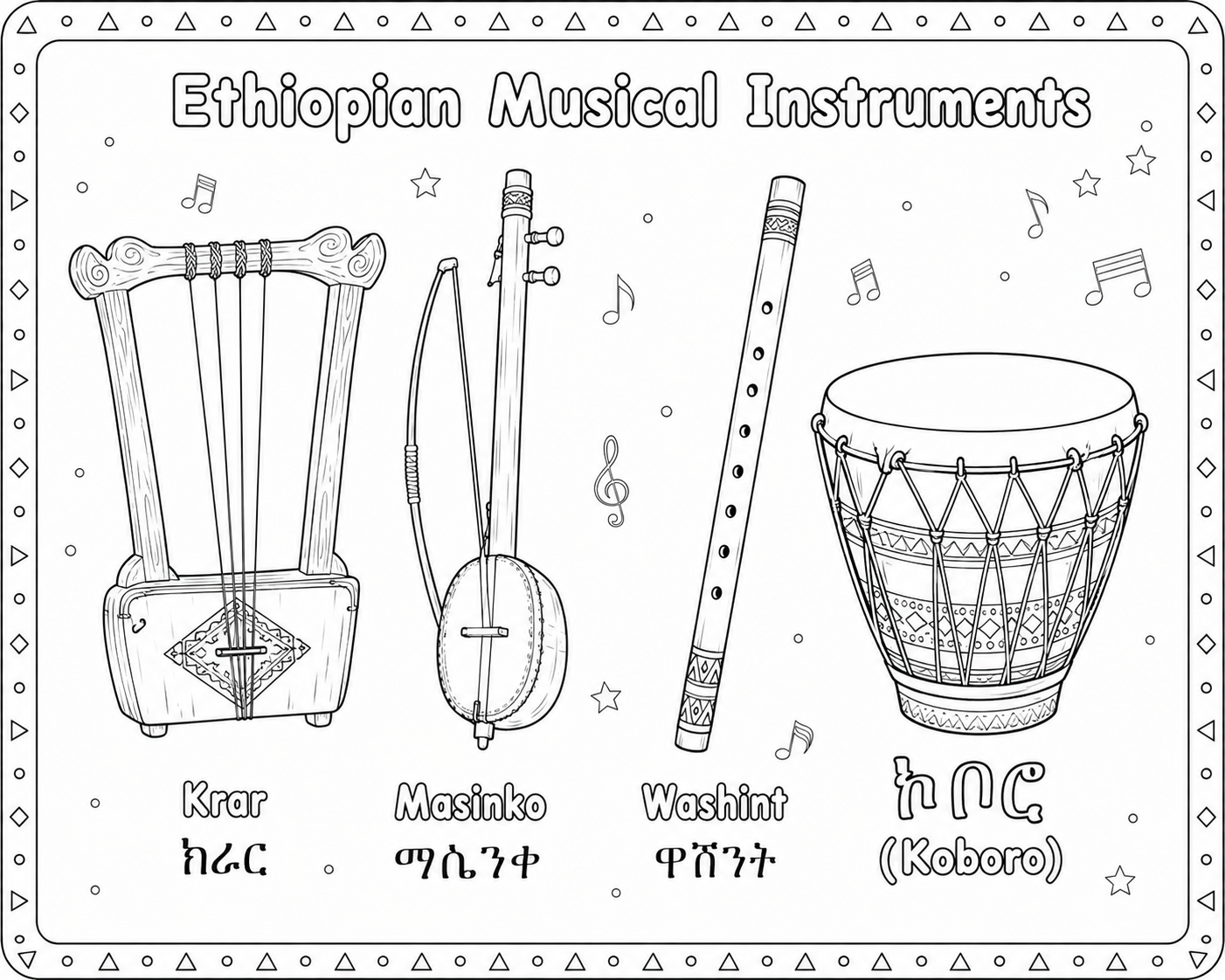
Ethiopian Musical Instruments colouring page

Ethiopian Musical Instruments

Meet the krar, masinko, washint and kebero.

Download PNG ↓

Games & Challenges

Learn by doing

Choose a game and begin. Every activity opens directly from one clear card.

Printable word searches

Find the connections

Two ready-to-use activities for classrooms, families and community gatherings. Words may appear horizontally, vertically, diagonally, forward or backward. The word lists remain part of the game and do not include separate glossary definitions.

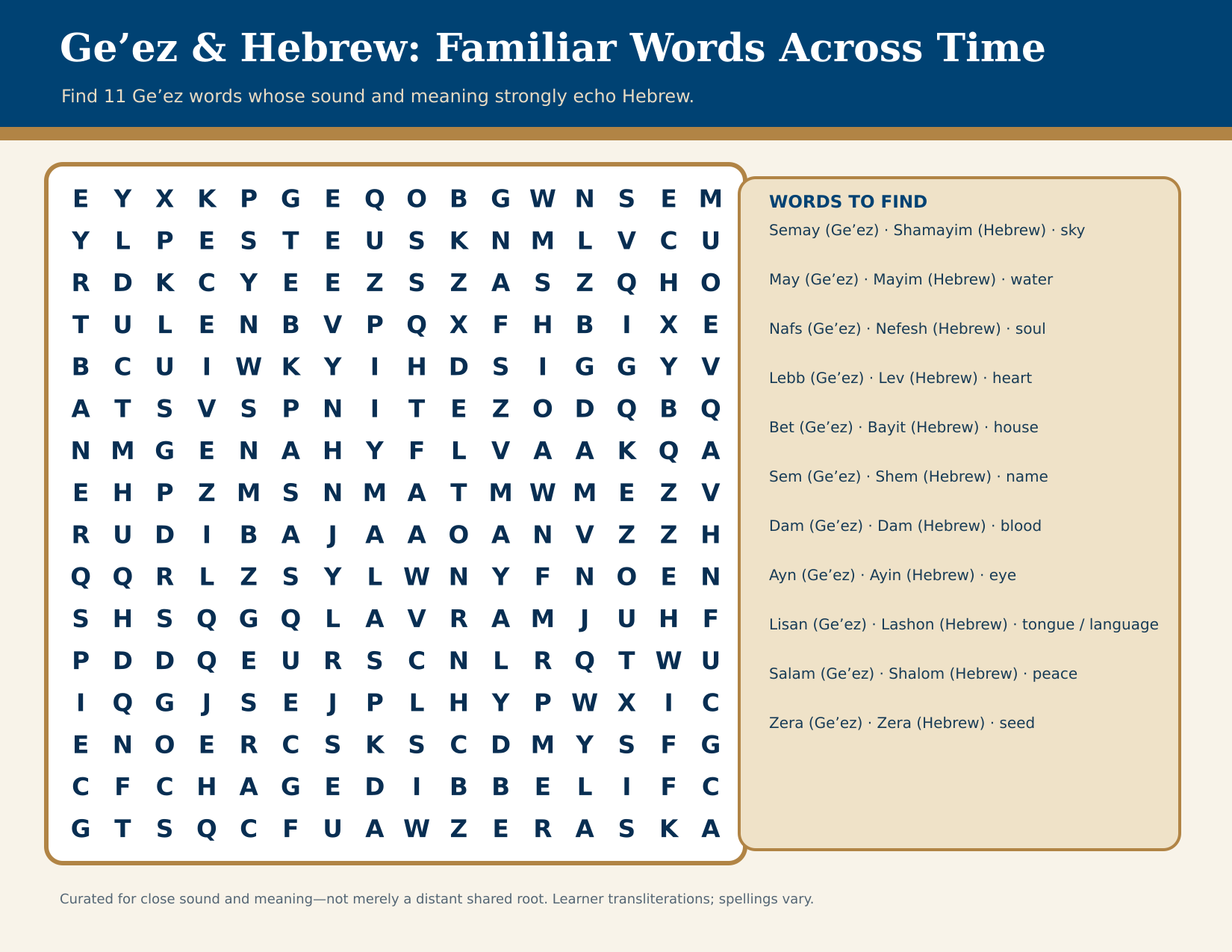
Ge’ez and Hebrew Familiar Words Across Time word search

Ge’ez & Hebrew: Familiar Words Across Time

Find 11 Ge’ez and Hebrew words with related sounds and meanings. Both languages belong to the Semitic family; these similarities can reflect shared linguistic inheritance and do not, by themselves, prove a particular migration history.

Download word search ↓
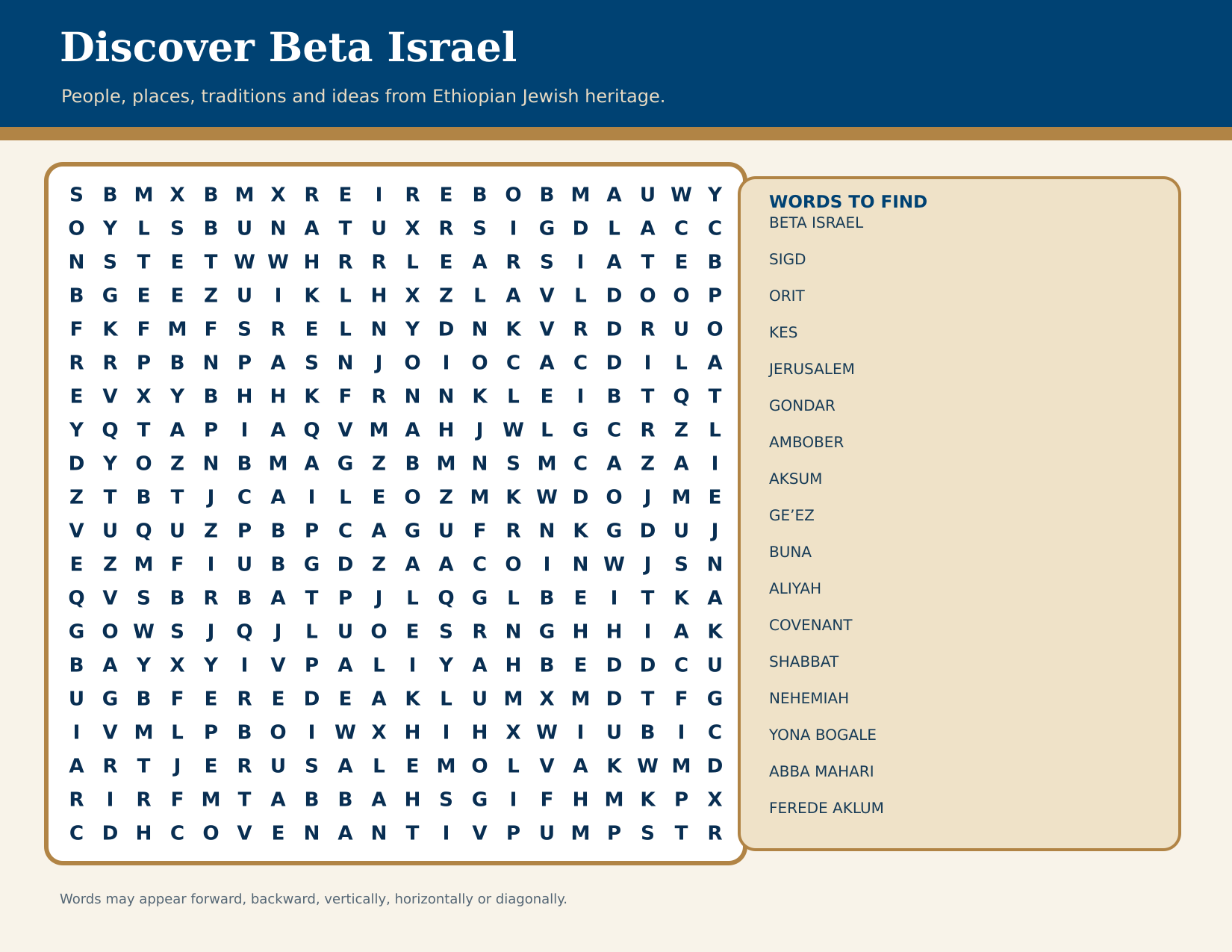
Beta Israel shared heritage word search

Beta Israel: A Shared Jewish Story

Find 17 people, places, traditions and ideas from Ethiopian Jewish heritage.

Download word search ↓

Interactive picture puzzle

Gathering
for Sigd

Rebuild the photograph of the Qessim beneath colourful ceremonial umbrellas, with Jerusalem in the background. Select one piece, then another, to swap their places.

Interactive card game

Match the People
to the Journey

Turn over two cards. Each match now uses wording limited to what the linked institutional sources support.

0/8 matches0 moves

Sources: Ethiopian Jewry Heritage Center · Sudan background · AAEJ Archives · Hazi Ovadia Archive

A chronology challenge

Put the Journey
in Order

This game has one clear goal: build chronological understanding by placing seven documented turning points from earliest to latest.

0/7Choose the earliest event first.

Choose next

Your timeline

    Interactive game

    Discover Ethiopia & Beta Israel

    Built from the updated community Kahoot. Journey from Ethiopia’s ancient civilization through Beta Israel’s sacred traditions, leaders, aliyah and Sigd.

    31 questions

    Discover Ethiopia & Beta Israel

    A facilitator-ready journey from Ethiopia’s ancient civilization to Beta Israel, Jerusalem and Sigd.

    Every answer explanation includes further reading. The comparative questions place Ethiopia within global history alongside other ancient civilizations.

    Lesson Plans & Programs

    Open. Build. Guide.

    Choose a ready-to-use lesson, build a tailored program for your group, or begin with the essential background for confident facilitation.

    Lesson Plans & Programs

    Choose a ready-made plan—or build your own

    Open a complete lesson, create a tailored program, or begin with the facilitator introduction.

    01Choose an Existing Lesson PlanOpen a complete, ready-to-use learning experience.↓

    Before you begin

    Prepare with confidence

    Start with the facilitator background, use the two-minute opening script, and review the key language before leading any activity.

    Open the facilitator introduction ↑
    40 minutes

    The Picture That Chose You

    An image-led gallery walk that begins with curiosity and introduces Beta Israel through observation, discussion and discovery.

    Download lesson plan ↓
    30 minutes

    What Would You Carry?

    A reflective activity about the possessions, values, faith and hope people carry through uncertain journeys.

    Download lesson plan ↓

    Facilitator note: These downloadable plans include background and reading lists. Please review the introduction and linked sources before facilitating.

    Ready-to-use learning

    One foundation. Three ways to gather.

    40minutes

    A meaningful introduction

    Story, central idea, guided discussion and one creative response.

    75minutes

    Explore and participate

    Context, voices, music, collaborative activity and reflection.

    120minutes

    A community experience

    Deeper learning, multiple stations, ceremony and shared gathering.

    Sources & further learning

    Continue the conversation

    The site brings community tradition, sacred text, documented history and scholarly interpretation into conversation. Linked sources invite readers to go deeper without interrupting the shared Jewish story.

    Sources accessed and checked

    Primary texts accessed

    Mentioned previously—but not used as checked evidence in this phase

    Full text was not accessed during this audit. These works must be read directly before page numbers, quotations or specific positions are attributed to them.

    • Sharon Shalom, From Sinai to Ethiopia.
    • Works attributed to Ephraim Isaac concerning Beta Israel origins and identity.
    • Steven Kaplan, The Beta Israel (Falasha) in Ethiopia.
    • James Quirin, The Evolution of the Ethiopian Jews.
    • Wolf Leslau, Falasha Anthology.
    • Kay Kaufman Shelemay, Music, Ritual, and Falasha History.
    • Gadi BenEzer, The Ethiopian Jewish Exodus.
    • The relevant Radbaz responsum and Rabbi Ovadia Yosef’s responsum in Yabia Omer. Institutional summaries were checked; the responsa themselves were not.
    Editorial notes & source review

    Editorial transparency

    How the sources are used

    These notes describe how wording is matched to sources. They do not rank the cultural importance of a tradition or place a community’s belonging on trial.

    ClaimSupporting sourceStatusConfidence / note
    Beta Israel’s precise origin and settlement date are unknown; several traditions and hypotheses exist.EJHC—Beginning of Jewish SettlementVerifiedHigh. The page states this directly and lists the alternatives.
    The Orit is an Octateuch comprising the Pentateuch, Joshua, Judges and Ruth.National Library of IsraelVerifiedHigh. Direct institutional description of the manuscripts.
    Sigd is observed on 29 Heshvan, fifty days after Yom Kippur, with fasting followed by rejoicing.EJHC—The Sigd HolidayVerifiedHigh.
    Nehemiah 8–9 provides the covenant-renewal framework used to explain Sigd.Nehemiah 8–9; EJHCVerifiedHigh for the textual relationship. The first historical observance is not dated by these sources.
    Written records become substantially fuller from the late 13th/14th century.EJHC—Gideonite KingdomVerifiedHigh within the institutional historical overview.
    Rabbi Azriel Hildesheimer’s 1864 appeal recognized Beta Israel as Jews and called for practical assistance.Hildesheimer appeal overviewVerifiedThe accessible English translation cites the Jewish Chronicle & Hebrew Observer of 4 November 1864.
    William Recant’s leadership in AAEJ, Operation Solomon advocacy and international JDC programs.Greater Miami Jewish FederationVerifiedInstitutional biography corroborates the core claims; dates and additional details were supplied directly to the project.
    Detailed biography of Yitzhak (Tsehaye) Elias.Hazi Ovadia ArchivePartially verifiedEarly association membership is supported; fuller claims require archive review.
    Specific work of Rabbi Menachem Waldman.Publisher biographyHuman review requiredInstitutional or primary documentation should replace the commercial biography.
    Published quiz answers and explanations.A direct source link is attached to each answerVerifiedThe quiz includes community history and comparative context about Ethiopia.
    Card-game biographical matches.EJHC, AAEJ Archives and Hazi Ovadia Archive links below the gameVerifiedWording narrowed to what the accessed pages state.
    All 47 book editions and summaries.Mixed publisher, library and discovery linksHuman review requiredCatalogue retained for discovery; every card now states that edition verification is pending.
    All music credits and selected recordings.Mixed direct recordings and targeted search linksPartially verifiedExact-recording status is shown on every card; search links are not treated as verification.

    Sources checked on accessible pages

    Ethiopian Jewry Heritage Center pages listed above; National Library of Israel Orit announcement; Knesset Sigd page; AAEJ About and Contact pages; Hazi Ovadia Archive introduction; Ezra 1 and Nehemiah 8–9.

    Sources not accessed in full

    The listed scholarly books, original halakhic responsa, full texts of catalogue books, and recordings reached only through search links. They are not used for quotations or page references.

    Claims requiring human follow-up

    Detailed biographies noted in the table; every entry in the withheld detailed timeline; all book editions and summaries; music credits without a specific recording; and sentence-level matrices for downloadable lesson plans.